Getting Started
Install
Optional extras: assertpy2[json] (JSONPath / JSON Schema), assertpy2[allure], assertpy2[behave].
Coming from the original assertpy?
assertpy2 is a drop-in replacement on Python 3.10+. See Migrating from assertpy for the one-line switch and what you gain.
Your first assertion
Wrap a value in assert_that() and chain assertions that read like a sentence:
from assertpy2 import assert_that

assert_that("foobar").is_length(6).starts_with("foo").ends_with("bar")
assert_that([1, 2, 3]).contains(1).does_not_contain(9).is_subset_of([1, 2, 3, 4])
Because every assertion is statically typed, your editor only suggests methods valid for the value's type, and a type checker flags misuse before the test runs. See Type Safety for how the overloads work.
When an assertion fails
A failing assertion raises an AssertionError with a precise message:
assert_that(5).is_greater_than(10)
# AssertionError: Expected <5> to be greater than <10>, but was not.
For dicts, dataclasses, and other structures, the pytest plugin renders a path-level diff that points straight at the differing field instead of dumping the whole value:
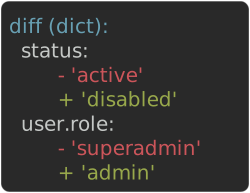
The same path-level diff backs matches_structure(), satisfies(), and each(). See
Errors & Reporting for the full diff format and configuration.
Collect multiple failures
Use soft assertions to report every failure at once instead of stopping at the first:
from assertpy2 import assert_that, soft_assertions

with soft_assertions():
    assert_that("foo").is_length(3)
    assert_that("foo").starts_with("x")   # collected
    assert_that("foo").ends_with("z")     # collected
Next steps
- Matchers for composable, reusable conditions.
- Fluent API for chaining, negation, and the collection pipeline.
- Browse the assertion reference in the navigation for every type-specific assertion.